
1. Introduction
The postpartum period is a crucial phase for both mothers and newborns; however, it is frequently overlooked regarding the provision of quality healthcare, particularly in low-resource settings [1]. Immediate postpartum anemia (IPPA) is defined as a maternal hemoglobin (Hgb) level falling below the normal physiological range shortly after childbirth. While the exact diagnostic threshold varies in the literature, commonly cited criteria include a hemoglobin level < 10 g/dL within 48 hours, < 11 g/dL within one week, or < 12 g/dL within six weeks postpartum [2][4]. Cesarean delivery (CD) involves the surgical extraction of a fetus after 28 weeks of gestation via an abdominal and uterine incision. Globally, CD rates have escalated substantially, rising from 7% in 1991 to 21% in 2024 [5].
The global prevalence of IPPA following cesarean delivery exhibits considerable geographic variation. In the United States, approximately 1.3 million cesarean deliveries are performed annually, with an estimated 100,000 women experiencing postpartum anemia [6]. Studies from Germany and Southern Uganda have reported severe postpartum anemia following cesarean delivery at prevalence rates of 7.3% and 6.79%, respectively [7, 8]. In Ethiopia, previous epidemiological investigations conducted in Addis Ababa and Southern Ethiopia documented prevalence rates of 29% and 28%, respectively [9][10].
IPPA constitutes a significant etiology of maternal morbidity and mortality. Globally, 57% of all maternal deaths occur during the postpartum period, with 50% of these fatalities happening within the critical first 24 hours; approximately 20% of these deaths are directly attributable to postpartum anemia [11][12]. In Ethiopia, where 65.1% of maternal mortality occurs postpartum, roughly 2% is linked directly to postpartum anemia [11]. Furthermore, severe postpartum anemia can increase the risk of maternal death threefold, particularly within the first 48 hours after delivery [13].
IPPA is a multifactorial pathology influenced by diverse clinical and demographic variables. Primary contributors include frank postpartum hemorrhage and pre-existing peripartum anemia, accounting for 2–25% of all cases [14, 15]. Additional significant determinants comprise endemic infections (e.g., malaria), hemoglobinopathies, adverse socioeconomic conditions, nutritional deficiencies, lower educational attainment, antepartum hemorrhage, advanced maternal age, high parity, short interpregnancy intervals, inadequate antenatal care (ANC) utilization, emergency cesarean delivery, and a mid-upper arm circumference (MUAC) measuring under 23 cm [1][2][7][9][13][16][17].
IPPA exerts a profoundly negative impact on the quality of life and general well-being of both the mother and her neonate. Sequelae include profound exhaustion, reduced occupational productivity, exertional dyspnea, tachycardia, dizziness, an increased susceptibility to infections, delayed wound healing, an elevated risk of postpartum depression, emotional lability, renal insufficiency, disseminated intravascular coagulation (DIC), impaired mother-infant bonding, and subsequent delays in childhood cognitive development [4][18][21].
To effectively prevent and control IPPA, robust national and international strategies have been formulated. These encompass the routine measurement and optimization of serum hemoglobin levels during ANC, alongside meticulous pre- and post-delivery assessments [10]. Prophylactic iron supplementation is strongly advised throughout the antenatal period and for 6–12 weeks postpartum, coupled with dietary counseling promoting iron-rich foods and pharmacological interventions to eradicate intestinal helminths [15][22][23]. The World Health Organization (WHO) has set a global target to reduce anemia among women of childbearing age by 50% by 2025, while the Ethiopian government has concurrently launched strategic initiatives to drive anemia prevalence below 12% by the same year [24][25].
Despite concerted efforts to mitigate IPPA, designated targets have largely been missed, particularly across Africa and within Ethiopia. There remains a critical lack of rigorous epidemiological studies investigating the specific determinants of IPPA after cesarean delivery in this region. Given that cesarean deliveries inherently carry a greater risk of postpartum blood loss and subsequent anemia [7, 26], and with global cesarean rates continuously rising [5], understanding these determinants is imperative. Previous research on this topic has predominantly relied on retrospective cross-sectional designs. Therefore, the present study aims to utilize an unmatched case-control design to incorporate additional surgical and obstetric variables, such as the presence of intra-abdominal adhesions, the number of prior cesarean sections, and the performance of concomitant surgical procedures. The objective is to precisely identify the factors determining immediate postpartum anemia following cesarean delivery at South Wollo Zone Public Hospitals, Northeast Ethiopia, in 2024.
2. Methods and Materials
2.1. Study Design and Area
An institutionally based unmatched case-control study was conducted in South Wollo Zone hospitals, Amhara Regional State, from April 10 to June 1, 2024. South Wollo, one of the 14 administrative zones in the Amhara region, is headquartered in Dessie, located 480 km from Bahir Dar and 401 km from Addis Ababa. According to the 2007 Census by the Central Statistical Agency (CSA) of Ethiopia, the zone has a population of 2,518,862, of which 50.4% are female [27]. The zone features 14 government hospitals (including comprehensive specialized, general, and primary hospitals) and is supported by 133 health centers and 523 health posts. All selected hospitals provide comprehensive maternal and child health services, including complicated and cesarean deliveries, managed by multidisciplinary teams of midwives, gynecologists, and emergency obstetric surgeons [28].
2.2. Sample Size Determination and Sampling Technique
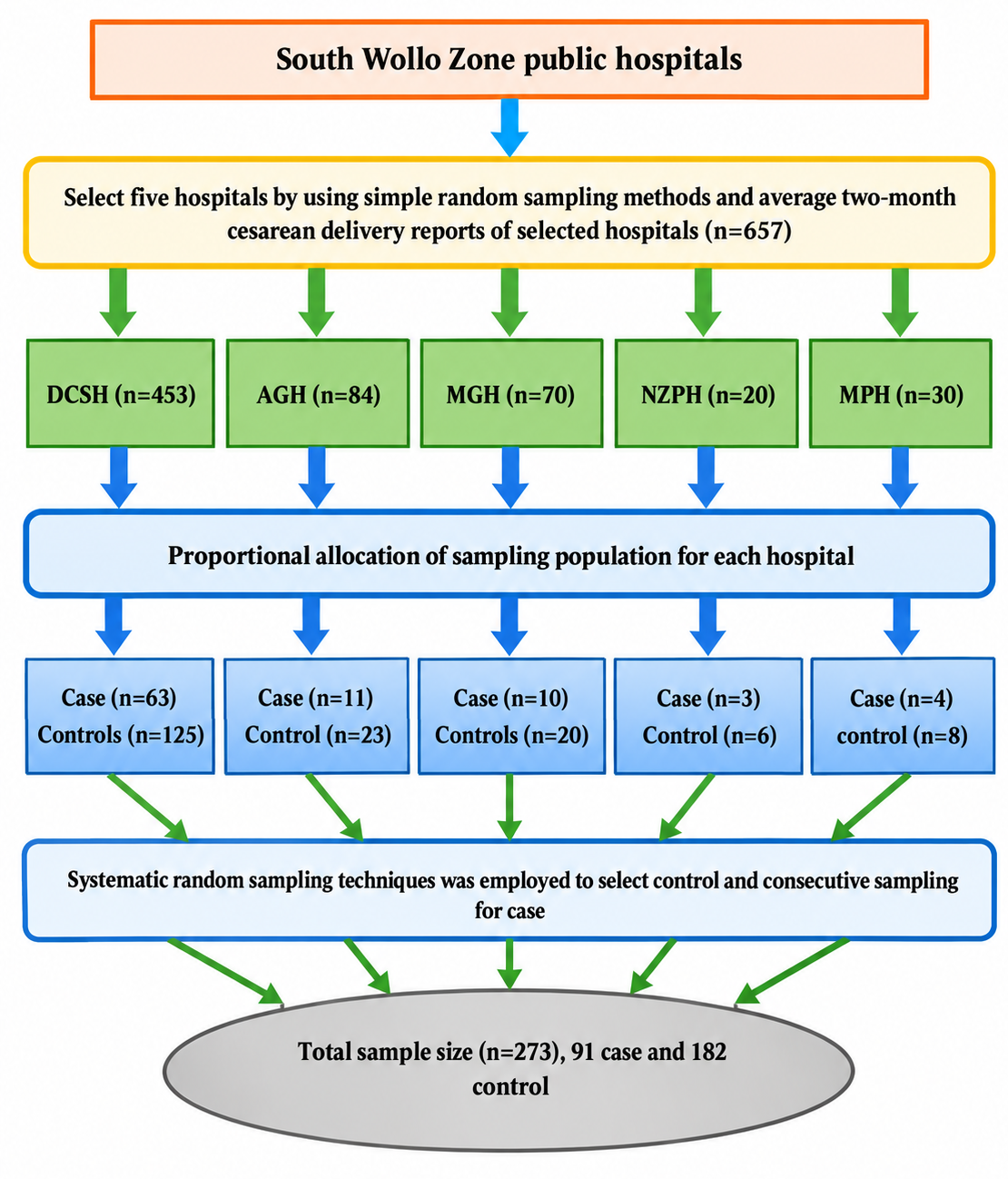
The sample size for this study was calculated via Epi Info statistical software version 7.2.0.6, with a two-sided confidence level of 95% and a power of 80%. A case‒to-control ratio of 1:2 was established to increase the statistical power. A simple random sampling method, specifically a lottery, was employed to select five hospitals from the 14 public hospitals in the South Wollo zone: Dessie Comprehensive Specialized Hospital, Akesta General Hospital, Mekaneselam General Hospital, Mekidela Primary Hospital, and Nigst Zewuditu Primary Hospital. Proportionate allocation was utilized on the basis of cesarean delivery estimates from the two months prior to the study, totaling 657 deliveries. The final sample size was determined to be 273, comprising 91 cases and 182 controls. Controls were selected via a systematic approach, choosing every third woman from the cesarean delivery admission-discharge book. To accommodate potential nonresponses, an additional 10% was added, resulting in a final sample size of 273 (91 cases and 182 controls) (Figure 1).
2.3. Study Variables
Dependent Variable: Immediate postpartum anemia after cesarean delivery.
Independent Variables:
-
Sociodemographic factors: Age, marital status, residence, occupation, monthly income, educational level, and partner demographics.
-
Obstetric factors: Gravidity, parity, history of abortion, ANC utilization, frequency of ANC visits, gestational age at delivery, interpregnancy interval, birth weight, preeclampsia, and antepartum/postpartum hemorrhage.
-
Micronutrient and comorbidity-related factors: Iron-folic acid (IFA) supplementation, IFA adherence, pre-delivery Hgb, MUAC, HIV, syphilis, malaria, urinary tract infections (UTI), and insecticide-treated net (ITN) utilization.
-
Cesarean section procedure-related factors: Uterine incision type, estimated operation duration, estimated blood loss (EBL), anesthesia type, number of previous cesarean sections, indications for CD, presence of adhesions, and execution of additional procedures (e.g., bilateral tubal ligation [BTL] or myomectomy).
2.4. Operational Definitions
Immediate Postpartum Anemia: Defined clinically as a maternal hemoglobin concentration < 10 g/dL within the first 24 hours postpartum.
Adherence to Iron Supplementation: Classified as "good" if the mother ingested iron supplements for ≥ 3 months, and "poor" if ingestion was < 3 months during the index pregnancy [2, 3, 11]. Mid-Upper Arm Circumference (MUAC): Based on UNICEF and WHO guidelines, measured on the non-dominant arm; a value < 23 cm indicates undernourishment, while ≥ 23 cm indicates adequate nourishment [3, 11].
2.5. Data Collection Tool and Procedures
Data were aggregated using pretested, structured, face-to-face interview questionnaires and validated data extraction checklists. Questionnaires were drafted in English, translated into Amharic, and subsequently back-translated to ensure semantic consistency. MUAC was meticulously measured using standard non-stretchable tapes. Approximately 8 hours post-delivery, following verbal informed consent, venous blood samples (1 mL) were drawn utilizing aseptic techniques. Hemoglobin levels were analyzed via automated hematology analyzers in the hospital laboratories, and the results were documented in medical records prior to maternal discharge. Anemic mothers were promptly managed according to national clinical guidelines.
2.6. Data Quality Assurance and Statistical Analysis
A pilot study comprising 5% of the sample (5 cases, 10 controls) was conducted at Kombolicha General Hospital to validate the tool. Data collectors and supervisors underwent intensive training regarding the study objectives, ethical engagement, and precise data collection methodologies. Data were digitally captured using Kobo Toolbox software (v. 2024.1.3), checked for absolute completeness, and exported to SPSS version 27 for rigorous analysis. Descriptive statistics were computed and summarized. Bivariable logistic regression was initially applied; variables yielding a p-value < 0.25 were advanced to a multivariable logistic regression model to adjust for potential confounders. Model fitness was confirmed using the Hosmer and Lemeshow goodness-of-fit test (p > 0.05), and multi-collinearity was ruled out via variance inflation factor (VIF < 10). Adjusted odds ratios (AORs) with 95% confidence intervals (CIs) and a p-value < 0.05 were deemed statistically significant.
3. Results
A total of 273 postnatal women (91 cases and 182 controls) participated, yielding a response rate of 100%. The mean age for cases was 27.35 (± SD 4.83) years, while controls averaged 28.13 (± SD 5.19) years. Regarding ANC utilization, 95.6% of cases and 97.8% of controls attended at least one ANC visit. However, a significant proportion of cases (53.8%) had only 1-4 ANC contacts. IFA supplementation was utilized by 84.6% of cases and 94% of controls, but poor adherence was notably higher among cases (51.9%) compared to controls (22.8%). Intraoperatively, extensive pelvic adhesions were identified in 60% of cases versus 33.3% of controls, and estimated blood loss exceeding 1000 mL was recorded in 40.7% of cases compared to just 16.5% of controls.
| Variable | Categories | Case | Control | Pearson Chi-Square |
| Age group | 15-24 | 25 (27.5%) | 46 (25.3%) | 0.915 |
| 25-34 | 54 (59.3%) | 110 (60.4%) | ||
| 35-49 | 12 (13.2%) | 26 (14.3%) | ||
| Educational status | No formal education | 36 (39.6%) | 35 (19.2%) | 0.003 |
| Primary education | 23 (25.3%) | 59 (32.4%) | ||
| Secondary education | 20 (22.0%) | 45 (24.7%) | ||
| College and above | 12 (13.2%) | 43 (23.6%) | ||
| Occupation of respondent | House wife | 44 (48.4%) | 93 (51.1%) | 0.884 |
| Daily laborer | 11 (12.1%) | 20 (11%) | ||
| Merchant | 20 (22%) | 43 (23.6%) | ||
| Government employ | 16 (17.6%) | 26 (14.3%) | ||
| Residence | Rural | 43 (47.3%) | 77 (42.3%) | 0.438 |
| Urban | 48 (52.7%) | 105 (57.7%) | ||
| Marital status | Single | 2 (2.2%) | 12 (6.6%) | 0.351* |
| Divorced | 2 (2.2%) | 4 (2.2%) | ||
| Married | 87 (95.6%) | 166 (91.2%) | ||
| Husband occupation | Daily laborer | 9 (10%) | 12 (6.9%) | 0.092 |
| Farmer | 31 (34.4%) | 39 (22.4%) | ||
| Merchant | 11 (12.2%) | 33 (19%) | ||
| Government/private employ | 39 (43.3%) | 90 (51.7%) | ||
| Estimated monthly income | < 2000 | 6 (6.6%) | 13 (7.1%) | 0.689 |
| 2000-5000 | 31 (34.1%) | 51 (28%) | ||
| 5001-10000 | 36 (39.6%) | 85 (46.7%) | ||
| >= 10001 | 18 (19.7%) | 33 (18.1%) | ||
| Husband education | No formal education | 28 (31.1%) | 40 (23%) | 0.006 |
| Primary education | 28 (31.1%) | 30 (17.2%) | ||
| Secondary education | 13 (14.4%) | 46 (26.4%) | ||
| College and above | 21 (23.3%) | 58 (33.3%) | ||
| Religion | Orthodox Christian | 33 (36.3%) | 57 (31.3%) | 0.514* |
| Muslim | 56 (61.5%) | 123 (67.6%) | ||
| Protestant | 2 (2.2%) | 2 (1.1%) |
| Variable | Categories | Case | Control | Chi-Square |
| Para | Primipara | 44 (48.4%) | 70 (38.5%) | 0.254 |
| Multipara | 40 (44%) | 99 (54.4%) | ||
| Grand multipara | 7 (7.7%) | 13 (7.1%) | ||
| Gravida | Primigravida | 36 (39.6%) | 78 (42.9%) | 0.603 |
| Multigravida | 55 (66.4%) | 104 (57.1%) | ||
| Ante natal care | Yes | 87 (95.6%) | 178 (97.8%) | 0.447* |
| No | 4 (4.4%) | 4 (2.2%) | ||
| Number of antenatal cares | 1-4 ANC contact | 49 (53.8%) | 47 (26.4%) | <0.0001 |
| 5-7 ANC contact | 19 (21.8%) | 88 (49.4%) | ||
| 8 ANC contact | 19 (21.8%) | 43 (24.2%) | ||
| Pregnancy interval | Less than 2 year | 12 (25.5%) | 25 (22.3%) | 0.662 |
| >= 2 year | 35 (74.5%) | 87 (77.7%) | ||
| Abortion | Yes | 11 (12.1%) | 15 (8.2%) | 0.307 |
| No | 80 (87.9%) | 167 (91.8%) | ||
| GA at delivery in week | Preterm | 23 (25.3%) | 30 (16.5%) | 0.909 |
| Post term | 3 (3.3%) | 14 (7.7%) | ||
| Unknown | 3 (3.3%) | 26 (14.3%) | ||
| Term | 62 (68.1%) | 112 (61.5%) | ||
| Number of births | Single | 85 (93.4%) | 178 (97.8%) | 0.089* |
| Twin | 6 (6.6%) | 4 (2.2%) | ||
| Antepartum hemorrhage | Yes | 29 (31.9%) | 27 (14.8%) | 0.001 |
| No | 62 (68.1%) | 155 (85.2%) | ||
| Pregnancy induced hypertension | Yes | 14 (15.4%) | 29 (15%) | 0.906 |
| No | 77 (84.6%) | 153 (84.1%) |
| Variable | Category | Case | Control | Chi-square |
| IFA intake | Yes | 77 (84.6%) | 171 (94%) | 0.012 |
| No | 14 (15.4%) | 11 (6%) | ||
| Gestational age IFA initiated | First trimester | 14 (18.2%) | 47 (27.5%) | 0.41 |
| Second trimester | 55 (71.4%) | 118 (69%) | ||
| Third trimester | 8 (10.4%) | 6 (3.5%) | ||
| Adherence to IFA tablets | Poor adherence | 40 (51.9%) | 39 (22.8%) | 0.0001 |
| Good adherence | 37 (48.1%) | 132 (77.2%) | ||
| Dewormed with mebendazole | Yes | 15 (16.5%) | 47 (25.8%) | 0.082 |
| No | 76 (83.5%) | 135 (74.2%) | ||
| Helminthes during pregnancy | Yes | 3 (3.3%) | 9 (4.9%) | 0.756* |
| No | 88 (96.7%) | 173 (95.1%) | ||
| ITN used | Yes | 29 (31.9%) | 51 (28%) | 0.510 |
| No | 62 (68.1%) | 131 (72%) | ||
| HIV/AIDS | Yes | 5 (5.5%) | 11 (6%) | 0.855 |
| No | 86 (94.5%) | 171 (94%) | ||
| Malaria positive | Yes | 3 (3.3%) | 5 (2.7%) | 1.000 |
| No | 88 (96.7%) | 177 (97.3%) | ||
| Syphilis positive | Yes | 8 (8.8%) | 14 (7.7%) | 0.753 |
| No | 83 (91.2%) | 168 (92.3%) | ||
| UTI positive | Yes | 3 (3.3%) | 8 (4.4%) | 0.757* |
| No | 88 (96.7%) | 174 (95.6%) | ||
| Pre-delivery Hgb | Hgb < 11.5 | 43 (47.3%) | 38 (20.9%) | <0.0001 |
| Hgb >= 11.5 | 48 (52.7%) | 144 (79.1%) | ||
| MUAC level | < 23 cm | 39 (42.9%) | 36 (19.8%) | <0.0001 |
| >= 23 cm | 52 (57.1%) | 146 (80.2%) |
| Variable | Category | Case | Control | Chi-square |
| Type of Cesarean delivery | Emergency | 78 (85.7%) | 157 (86.3%) | 0.902 |
| Elective | 13 (14.3%) | 25 (13.7%) | ||
| If emergence stage of labor | First stage of labor | 54 (69.2%) | 118 (75.2%) | 0.334 |
| Second stage of labor | 24 (30.8%) | 39 (24.8%) | ||
| Number of Cesarean deliveries | Primary | 46 (50.5%) | 140 (76.9%) | <0.0001 |
| Repeat or >=2 | 45 (49.5%) | 42 (23.1%) | ||
| Adhesion | Yes | 27 (60%) | 14 (33.3%) | 0.013 |
| No | 18 (40%) | 28 (66.7%) | ||
| Estimated operation duration | less than 40 minutes | 63 (69.2%) | 134 (73.6%) | 0.445 |
| >= 40 minute | 28 (30.8%) | 48 (26.4%) | ||
| Type of uterine incision | LUSTC/S | 90 (98.9%) | 181 (99.5%) | 1.000 |
| classical incision | 1 (1.1%) | 1 (0.5%) | ||
| Estimated blood loss | less than 500 ml | 39 (42.9%) | 82 (45.1%) | <0.0001 |
| 500-1000 ml | 15 (16.5%) | 70 (38.5%) | ||
| >1000 ml | 37 (40.7%) | 30 (16.5%) | ||
| Type of anesthesia | General | 11 (12.1%) | 17 (9.3%) | 0.481 |
| Spinal | 80 (87.9%) | 165 (90.7%) | ||
| Additional procedure done | Yes | 34 (37.4%) | 23 (12.6%) | <0.0001 |
| No | 57 (62.6%) | 159 (87.4%) | ||
| Procedure done by | Gynecologist | 16 (17.6%) | 29 (15.9%) | 0.830 |
| Resident | 35 (38.5%) | 66 (36.3%) | ||
| IESO | 40 (44%) | 87 (47.8%) | ||
| Neonatal status | Alive | 89 (97.8%) | 176 (96.7%) | 0.723* |
| Dead | 2 (2.2%) | 6 (3.3%) | ||
| Weight of neonate | less than 4000 | 85 (93.4%) | 166 (91.2%) | 0.529 |
| >= 4000 | 6 (6.6%) | 16 (8.8%) |
| Variables | Category | Case % | Control % | COR (95% CI) | AOR (95% CI) | P value |
| Educational status | No formal education | 36 (39.6) | 35 (19.2) | 3.68 (1.67-8.13) | 2.71 (0.82-8.96) | 0.101 |
| Primary education | 23 (25.3) | 59 (32.4) | 1.39 (0.62-3.11) | 0.68 (0.19- 2.42) | 0.557 | |
| Secondary education | 20 (22) | 45 (24.7) | 1.59 (0.69-3.64) | 1.18 (0.35-3.96) | 0.778 | |
| College and above | 12 (13.2) | 43 (23.6) | 1 | 1 | ||
| Husband occupation | Daily laborer | 9 (10) | 12 (6.9) | 1.73 (0.67-4.44) | 3.02 (0.84-10.83) | 0.089 |
| Farmer | 31 (34.4) | 39 (22.4) | 1.83 (1.0-3.35) | 1.58 (0.68-3.64) | 0.278 | |
| Merchant | 11 (12.2) | 33 (19) | 0.76 (0.35-1.67) | 0.47 (0.16- 1.34) | 0.162 | |
| Government employee | 39 (43.3) | 90 (51.7) | 1 | 1 | ||
| Husband education | No formal education | 28 (31.1) | 40 (23) | 1.93 (0.96-3.87) | 1.99 (0.68-5.81) | 0.204 |
| Primary education | 28 (31.1) | 30 (17.2) | 2.57 (1.25-5.28) | 1 (0.30-3.28) | 0.994 | |
| Secondary education | 13 (14.4) | 46 (26.4) | 0.78 (0.35-1.72) | 0.82 (0.24-2.73) | 0.748 | |
| College and above | 21 (23.3) | 58 (33.3) | 1 | 1 | ||
| Number of births | Single | 85 (93.4) | 178 (97.8) | 1 | 1 | |
| Twin | 6 (6.6) | 4 (2.2) | 3.14 (0.86-11.42) | 2.51 (0.45-13.82) | 0.290 | |
| Number of ANC contact | 1-4 ANC contact | 49 (53.8) | 47 (26.4) | 2.35 (1.20-4.62) | 3.29 (1.35-8.00) | 0.008 |
| 5-7 ANC contact | 19 (21.8) | 88 (49.4) | 0.48 (0.23-1.01) | 0.40 (0.16-0.98) | 0.046 | |
| 8 ANC contact | 19 (21.8) | 43 (24.2) | 1 | 1 | ||
| Antepartum hemorrhage | Yes | 29 (31.9) | 27 (14.8) | 2.68 (1.47-4.89) | 2.11 (0.94-4.74) | 0.069 |
| No | 62 (68.1) | 155 (85.2) | 1 | 1 | ||
| IFA intake | No | 14 (15.4) | 11 (6) | 2.82 (1.22-6.51) | 1.77 (0.51-6.11) | 0.361 |
| Yes | 77 (84.6) | 171 (94) | 1 | 1 | ||
| Adherence to IFA tablets | Poor adherence | 40 (51.9) | 39 (22.8) | 3.65 (2.06-6.48) | 4.59 (2.13-9.87) | <0.001 |
| Good adherence | 37 (48.1) | 132 (77.2) | 1 | 1 | ||
| Dewormed with Mebendazole | No | 76 (83.5) | 135 (74.2) | 1.76 (0.92-3.36) | 1.18 (0.48-2.89) | 0.715 |
| Yes | 15 (16.5) | 47 (25.8) | 1 | 1 | ||
| Pre-delivery Hgb | Hgb < 11.5 | 43 (47.3) | 38 (20.9) | 3.39 (1.96-5.85) | 2.33 (1.11-4.90) | 0.025 |
| Hgb >= 11.5 | 48 (52.7) | 144 (79.1) | 1 | 1 | ||
| MUAC level | <23 cm | 39 (42.9) | 36 (19.8) | 3.04 (1.75-5.28) | 3.76 (1.71-8.29) | 0.001 |
| >=23 cm | 52 (57.1) | 146 (80.2) | 1 | 1 | ||
| No of cesarean Delivery | Repeat or >=2 | 45 (49.5) | 42 (23.1) | 3.26 (1.90-5.57) | 3.95 (1.86-8.39) | 0.0001 |
| Primary | 46 (50.5) | 140 (76.9) | 1 | 1 | ||
| Adhesion | Yes | 27 (60) | 14 (33.3) | 3.00 (1.24-7.2) | 0.84 (0.25-2.82) | 0.781 |
| No | 18 (40) | 28 (66.7) | 1 | 1 | ||
| Estimated blood loss | >1000 ml | 37 (40.7) | 30 (16.5) | 2.59 (1.40-4.79) | 3.43 (1.48-7.94) | 0.004 |
| 500-1000 ml | 15 (16.5) | 70 (38.5) | 0.45 (0.22-0.88) | 0.86 (0.35-2.08) | 0.747 | |
| less than 500 ml | 39 (42.9) | 82 (45.1) | 1 | 1 | ||
| Additional procedure done | Yes | 34 (37.4) | 23 (12.6) | 4.12 (2.24-7.58) | 3.26 (1.34-7.93) | 0.009 |
| No | 57 (62.6) | 159 (87.4) | 1 | 1 |
4. Discussion
Immediate postpartum anemia (IPPA) represents a profound public health problem, as it imposes a substantial disease burden during the critical period of early maternal-infant interaction. Although numerous studies have investigated general postpartum anemia globally and within Ethiopia, there is a distinct paucity of literature specifically evaluating the determinants of immediate postpartum anemia directly following cesarean delivery. This scarcity limits extensive direct comparisons but underscores the scientific imperative of the present study.
In this study, mothers with a history of only 1-4 ANC visits were three times more likely to develop IPPA after cesarean delivery compared to those who completed 8 ANC contacts (AOR, 3.29; 95% CI: 1.35-8.00). This finding aligns with studies conducted in Debre Markos [2], Harari Regional State [3], Dire Dawa [4], Southern Ethiopia [10], and Nairobi, Kenya [29]. A robust pathophysiological justification is that women with inadequate ANC contacts do not receive sufficient nutritional counseling or prophylactic health education. Consequently, they are less likely to obtain adequate iron and folic acid supplements, which are critical for erythropoiesis. Furthermore, limited ANC visits preclude the early identification and clinical optimization of pre-existing risk factors, thereby exacerbating the susceptibility to IPPA [3][11][30].
Furthermore, mothers demonstrating poor adherence to IFA supplementation were nearly five times more likely to suffer from IPPA compared to those exhibiting good adherence (AOR, 4.59; 95% CI: 2.13-9.87). This finding strongly corroborates previous research conducted in Debre Markos [2], Shewarobit [14], Gondar [31], and Pakistan [32]. The primary physiological mechanism explaining this association is the profound depletion of maternal iron stores resulting from the exponentially high physiological demand for iron throughout gestation and the inevitable blood loss during surgical delivery [25].
Nutritional status also served as a major determinant. Mothers presenting with a MUAC < 23 cm were nearly four times more likely to experience IPPA than those with a MUAC ≥ 23 cm (AOR, 3.76; 95% CI: 1.71-8.29). This is consistent with findings from Debre Markos, East Gojjam, and Shewarobit [2, 11, 14]. The fundamental etiology of iron deficiency anemia in these cohorts is severe nutritional deficit. A MUAC measurement below 23 cm serves as a reliable surrogate marker for poor muscle mass and chronic inadequate energy intake. The linear physiological relationship between maternal MUAC and serum hemoglobin concentration further validates this profound association [11].
Intraoperative variables heavily influenced outcomes. Women who sustained an estimated blood loss > 1000 mL during cesarean delivery were three times more likely to develop IPPA compared to those with a blood loss < 500 mL (AOR, 3.43; 95% CI: 1.48-7.94). According to the American College of Obstetricians and Gynecologists (ACOG), postpartum hemorrhage (PPH) is definitively classified as a blood loss exceeding 1000 mL, irrespective of the delivery modality [33][35]. This finding is broadly supported by literature from Ethiopia [2, 11, 14], Saudi Arabia [36], India [17], and the United States [7]. Massive intraoperative hemorrhage directly depletes intravascular volume and circulating hemoglobin mass, severely impairing tissue oxygenation and exhausting the reticuloendothelial iron stores necessary for compensatory erythropoiesis. Clinical data explicitly indicate that a 1000 mL blood loss can precipitate a rapid hemoglobin drop of ≥ 2 g/dL [37].
Mothers possessing a preoperative hemoglobin level < 11.5 g/dL were over two times more likely to develop IPPA compared to those with a level ≥ 11.5 g/dL (AOR, 2.33; 95% CI: 1.11-4.90). This finding perfectly parallels studies from Harari [3], Dire Dawa [4], India [17], and California [7]. Pre-existing peripartum anemia inherently compromises myometrial contractility and disrupts normal coagulation cascades. The ensuing hypoxia at the cellular level precipitates uterine atony—the leading cause of primary postpartum hemorrhage—thereby initiating a vicious cycle that culminates in severe IPPA [38].
Surgical history significantly amplified risk. Women who had undergone one or more previous cesarean deliveries were four times more likely to develop IPPA compared to primiparous surgical patients (AOR, 3.95; 95% CI: 1.86-8.39). This corroborates studies from Harari [3] and Wurzburg, Germany [39]. Physiologically and anatomically, repeat cesarean sections are frequently complicated by dense intra-abdominal adhesions, abnormal placentation (e.g., placenta accreta spectrum), scar dehiscence, and unintended uterine extensions, all of which exponentially increase operative difficulty and the risk of massive intraoperative hemorrhage [40, 41].
Finally, the execution of additional surgical procedures during the primary cesarean section (such as myomectomy, bilateral tubal ligation, or the placement of uterine compression sutures) tripled the likelihood of developing IPPA (AOR, 3.26; 95% CI: 1.34-7.93). Both concurrent myomectomy and unintended extensions of the uterine incision obligate the disruption of highly vascularized gravid tissues, inexorably increasing total blood loss [42]. Furthermore, managing uterine extensions or performing adjunct surgeries dramatically increases operative duration, which independently correlates with higher cumulative blood loss [43].
4.1. Limitations
Since the participants were required to self-report behaviors and activities over the preceding ten months, recall bias is an inherent limitation. Additionally, because the study was strictly institutional-based, the generalizability of the findings to the broader, non-hospitalized community may be constrained. Finally, the study participants originated from highly diverse geographical areas with varying altitudes, making precise mathematical adjustments of individual hemoglobin levels based on altitude logistically difficult.
5. Conclusion
This robust analysis reveals that attending only 1-4 ANC contacts, poor adherence to IFA supplementation, a MUAC < 23 cm, a preoperative hemoglobin level < 11.5 g/dL, an estimated intraoperative blood loss > 1000 mL, the execution of additional surgical procedures during cesarean delivery, and a history of two or more previous cesarean sections are significant, independent predictors of immediate postpartum anemia after cesarean delivery. This study strongly recommends intensive public health education regarding the critical importance of regular antenatal care, fortified adherence to IFA supplementation, and comprehensive nutritional counseling. Furthermore, hospital protocols for rigorous preoperative anemia screening and aggressive intraoperative hemorrhage management must be optimized. Targeted surgical planning and intervention strategies must be instituted for patients undergoing repeat cesarean deliveries. Future research should prioritize prospective cohort designs and incorporate standardized hemoglobin adjustments for altitude to ensure more precise epidemiological analyses.
Declarations
Funding
This research received no specific grant from any funding agency in the public, commercial, or not-for-profit sectors. All interpretations, data analyses, and scientific opinions presented in this study are exclusively those of the authors.
Institutional Review Board Statement
Ethical clearance and formal approval were obtained from the Wollo University College of Medical and Health Sciences Research and Ethical Review Committee (Reference Number: CMHS/524/2016).
Informed Consent Statement
Written informed consent was systematically obtained from all participating postpartum women prior to the administration of the survey and the extraction of blood samples.
Data Availability Statement
All data supporting the findings of this study are comprehensively included within the main manuscript.
Acknowledgements
The authors wish to extend their profound gratitude to Wollo University for providing the requisite ethical clearance. We also deeply appreciate all the study participants, dedicated data collectors, and meticulous supervisors for their invaluable cooperation throughout the duration of this research.
Conflicts of Interest
The authors unequivocally declare that they have no conflicts of interest.