
1. Introduction
Ambient air pollution constitutes a major global public health challenge, with fine particulate matter (PM2.5) recognized as one of its most deleterious components. Due to its diminutive aerodynamic equivalent diameter (≤2.5 µm), PM2.5 can penetrate deeply into the alveolar regions of the lungs and subsequently enter the systemic circulation. Acute and chronic exposures to PM2.5 are intrinsically linked to systemic inflammation, oxidative stress, endothelial dysfunction, and a commensurately increased risk of respiratory and cardiovascular morbidity and mortality. The epidemiological burden of disease attributable to ambient PM2.5 is disproportionately high in low- and middle-income countries (LMICs), where rapid and often unregulated urban growth, energy insecurity, and inadequate environmental monitoring infrastructures converge to escalate population vulnerability [1-4].
Crucially, the profile of urban air pollution is not uniform across diverse geographic settings. Its magnitude, precise seasonality, and resultant health effects are profoundly shaped not only by the nature of local emission sources but also by overarching climatic and topographical constraints. New Delhi, situated within the Indo-Gangetic Plain, represents a paradigm of persistently high PM2.5 exposure. This chronic pollution state is driven by a complex interplay of dense vehicular traffic, industrial emissions, widespread biomass burning, ubiquitous construction dust, and seasonal atmospheric stagnation [5-8]. In stark contrast, Bishkek exemplifies a distinct urban pollution environment where a mountain-basin topography, severe winter thermal inversions, heavy reliance on domestic coal combustion for heating, and an aging vehicle fleet synergistically contribute to the acute seasonal accumulation of atmospheric pollutants [10-13]. Although the annual mean PM2.5 concentration in Bishkek is statistically lower than that in New Delhi, the profound winter pollution episodes in Bishkek frequently reach atmospheric concentrations of considerable clinical concern [10-13].
Despite these recognized public health threats, comparative epidemiological evidence derived from cities with such contrasting exposure profiles remains conspicuously limited, particularly regarding Central Asian environments. The scientific literature is substantially more developed and granular for New Delhi than for Bishkek, engendering an uneven evidence base that hinders the comprehensive evaluation of the environmental health burden and the formulation of targeted interventions. This disparity is critically important because climatic and geographic variables may substantially modify both the exposure patterns and the severity of the resulting health outcomes [10-17].
Therefore, the primary aim of this scoping review is to systematically compare PM2.5 exposure patterns and their associated respiratory and cardiovascular health risks in New Delhi and Bishkek, placing a particular emphasis on the mediatory role of climatic and geographic influences. By synthesizing the extant evidence, this review endeavors to clarify how disparate urban environments generate distinct pollution-health phenotypes and to advocate for more context-specific, geographically informed approaches to air quality management and public health policy.
2. Methods
2.1. Study Design
This study was conceptualized and conducted as a systematic scoping review to rigorously examine the comparative health burden of PM2.5 exposure in New Delhi and Bishkek. A scoping methodology was strategically selected because the available evidence encompasses highly diverse study designs, varied exposure metrics, and heterogeneous clinical outcomes. Furthermore, the literature emanating from the two distinct geographical settings is markedly uneven in both volume and methodological depth. The review was purposefully structured to synthesize environmental and epidemiological data while meticulously accounting for topographical and climatic effect modifiers intrinsic to the Indo-Gangetic Plain and the Central Asian mountain-basin settings.
2.2. Search Strategy and Information Sources
A comprehensive, multi-stage literature search was executed using primary electronic databases, including PubMed/MEDLINE, Google Scholar, and ScienceDirect. To bolster the identification and rigorous cross-checking of relevant peer-reviewed literature, supplementary structured evidence retrieval was conducted using the Consensus AI research engine. The sophisticated search strategy amalgamated specific Medical Subject Headings (MeSH) and free-text keywords related to atmospheric exposure, clinical outcomes, and geographical locators. Exposure-related search parameters included “PM2.5,” “particulate matter,” “air quality index,” “thermal inversion,” and “atmospheric stability.” Outcome-related parameters incorporated “cardiovascular mortality,” “respiratory morbidity,” “COPD exacerbation,” and “ischemic heart disease.” Geographical parameters explicitly utilized “New Delhi,” “Bishkek,” “Indo-Gangetic Plain,” and “Kyrgyzstan.”
2.3. Study Selection
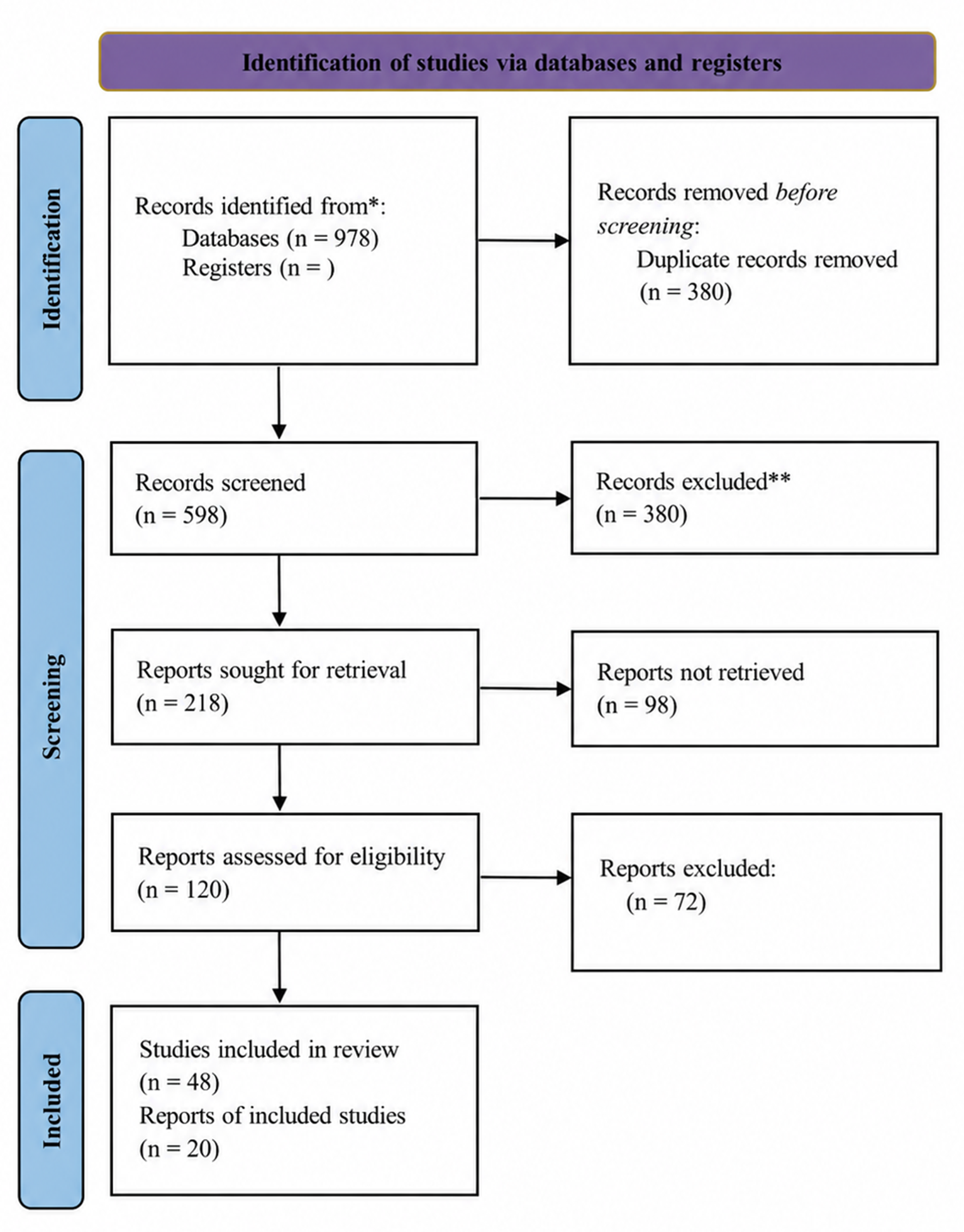
The initial database search yielded 978 records. Following the systematic removal of 380 duplicate records, 598 unique records remained for meticulous title and abstract screening. From this pool, 218 reports were identified for full-text retrieval, and 120 full-text articles were subsequently subjected to a stringent eligibility assessment. Ultimately, 48 studies satisfied all inclusion criteria and were incorporated into the final qualitative synthesis. Among this cohort, 20 studies were specifically prioritized for in-depth comparative interpretation, predicated on their superior methodological rigor, precise characterization of exposure parameters, and robust adjustment for critical seasonal and socioeconomic confounders (Figure 1).
2.4. Eligibility Criteria
The inclusion and exclusion parameters for this review are delineated in Table 1.
| Category | Inclusion Criteria | Exclusion Criteria |
| Study Type | Peer-reviewed studies, cohort, time-series, systematic reviews | Editorials, commentaries, lab-only studies |
| Exposure | Ambient PM2.5, PM10, AQI data | Indoor-only or occupational-only exposure |
| Population | Urban populations (New Delhi, Bishkek) | Rural-only without ambient exposure link |
| Outcomes | Respiratory/cardiovascular morbidity, mortality | No clinical endpoints |
2.5. Data Extraction and Synthesis
Relevant data were systematically extracted utilizing a standardized, predefined analytical framework. The principal variables of scientific interest encompassed mean annual and seasonal PM2.5 concentrations, pertinent environmental modifiers (e.g., thermal inversion heights, prevailing wind vectors), and precisely defined respiratory and cardiovascular outcomes quantified via relative risks, odds ratios, hospital admission trajectories, or mortality metrics. Given the inherent heterogeneity of the included studies regarding research design, exposure quantification methodologies, and outcome definitions, a comprehensive narrative synthesis approach was employed. For New Delhi, the synthesis specifically illuminated long-term, high-burden exposure dynamics and their robust associations with chronic disease paradigms. Conversely, for Bishkek, the analytical synthesis centered on acute seasonal pollution peaks and the exacerbating effects of localized pollutant trapping invariably associated with winter heating practices and intrinsic basin topography.
2.6. Quality Considerations
The methodological quality of the included studies was appraised descriptively, focusing on the precision of the exposure assessment methodologies, the clinical validity of the defined health outcomes, and the rigor with which the studies controlled for dominant confounders, notably seasonality and socioeconomic status. As this review relied exclusively on the synthesis of secondary, previously published data, formal institutional ethical approval was not mandated.
3. Results
3.1. Global Evidence on PM2.5 and Health Risk
The comprehensively reviewed literature unequivocally demonstrates that acute and chronic PM2.5 exposure is robustly associated with increased all-cause, cardiovascular, and cerebrovascular mortality, alongside a substantial exacerbation of chronic respiratory diseases, notably chronic obstructive pulmonary disease (COPD) and bronchial asthma [1-4]. Sustained, long-term exposure is mechanistically linked to clinically significant increases in ischemic heart disease and stroke-related mortality per incremental elevation in ambient PM2.5 concentrations. Nevertheless, a critical limitation remains: the vast majority of established exposure-response functions are derived from epidemiological cohorts in high-income settings. This geographical bias raises profound scientific concerns regarding their direct linear transferability to the heavily polluted, socioeconomically complex urban environments characteristic of LMICs.
3.2. Air Pollution Profile in New Delhi
The scientific literature consistently characterizes New Delhi as a chronic, high-exposure atmospheric environment. Annual mean PM2.5 concentrations are routinely reported in the range of 100 to 140 µg/m³ [32-34]. Seasonal variance is acutely pronounced, with the highest particulate concentrations historically observed during the winter and immediate post-monsoon periods. During these critical windows, a confluence of stagnant atmospheric conditions, extensive regional crop residue burning, and a significantly depressed planetary boundary layer height culminate in massive pollutant accumulation [35][36][46]. Multiple studies document extreme, transient hourly peaks during profound winter smog episodes and major cultural festival periods [39][45]. The predominant sources contributing to this toxic burden encompass ubiquitous vehicular emissions, unregulated industrial activity, rampant biomass burning, and suspended crustal dust, compounded by the documented presence of highly toxic trace metals such as chromium, lead, and manganese [38][43][47].
3.3. Health Outcomes in New Delhi
Epidemiological evidence emanating from New Delhi consistently and strongly links elevated ambient PM2.5 exposure with a spectrum of adverse outcomes: an increased prevalence of acute respiratory symptoms, significant exacerbations of asthma and COPD, a surge in cardiovascular hospital admissions, and elevated all-cause mortality rates [35-42]. Quantitative mortality estimates derived from the reviewed literature indicate measurable, statistically significant increases in all-cause mortality corresponding to every 10 µg/m³ increment in PM2.5. Furthermore, the literature robustly identifies specific highly vulnerable demographic cohorts, encompassing young children, the elderly, individuals with pre-existing cardiopulmonary pathologies, and an expansive population of outdoor occupational workers [35][43][48].
3.4. Air Pollution Profile in Bishkek
Bishkek demonstrates a fundamentally different, yet clinically profound, exposure profile. The annual mean PM2.5 concentration is quantitatively lower than that observed in New Delhi, averaging approximately 48 µg/m³; however, catastrophic winter peaks routinely escalate to concentrations between 200 and 300 µg/m³ [1][7][19]. The primary anthropogenic contributors to this acute seasonal crisis include rampant coal-based domestic heating, emissions from a largely unregulated motor vehicle fleet, and localized industrial or power-generation sources [7][19]. Crucially, the local mountain-basin topography, combined with severely restricted atmospheric ventilation, profound thermal inversions, and pronounced urban heat island effects, are repeatedly and definitively identified in the literature as the paramount drivers of winter pollutant trapping and accumulation [1][7][14].
3.5. Health Outcomes in Bishkek
In comparison to the robust dataset available for New Delhi, the epidemiological literature specifically focused on Bishkek is quantitatively less extensive and lacks robust longitudinal depth. Nonetheless, the available data consistently point to a substantial and concerning respiratory disease burden. This includes a worryingly high prevalence of COPD in specific population subsets and a marked increase in the incidence of pediatric lower respiratory tract infections [3][17][24][25]. While cardiovascular disease constitutes a dominant overall health burden in Kyrgyzstan, city-specific etiological analyses directly linking cardiovascular events to ambient PM2.5 fluctuations in Bishkek remain critically limited [2][15][16]. Furthermore, the pervasive reliance on solid fuels for household energy use significantly amplifies total particulate exposure, thereby compounding the overarching health vulnerability of the population [8][18][24][27].
3.6. Climatic and Geographic Modulation
A cardinal finding of this scoping review is that intrinsic climatic and geographic conditions profoundly shape the exposure paradigms in both urban centers. In New Delhi, the air pollution crisis is intrinsically dictated by the macro-dynamics of the Indo-Gangetic Plain, facilitating the massive regional transport of smoke and dust, coupled with the severe seasonal suppression of vertical atmospheric mixing [32][46]. Conversely, in Bishkek, it is the highly localized mountain-basin topography, inherent physical limitations on horizontal ventilation, and persistent, deep winter thermal inversions that reliably orchestrate recurrent, severe seasonal pollutant trapping [1][7][14][30]. These distinct patterns robustly support the scientific interpretation that PM2.5-related health risk is not solely determined by raw emission inventories but is profoundly modulated by the specific atmospheric and geographical context of the locale (Tables 2 and 3).
| PM2.5 Level | Category | Health Implications |
| Moderate–Unhealthy | Annual averages | Breathing discomfort; risk for sensitive groups |
| Very Unhealthy–Hazardous | Winter peaks (>400 µg/m³) | Acute respiratory events, COPD exacerbations, cardiovascular stress |
| Feature | New Delhi: The Chronic Megacity | Bishkek: The Seasonal Basin |
| Exposure Phenotype | Sustained annual high-burden exposure. | Episodic, extreme winter toxicity. |
| Pathogenic Profile | Mixed vehicular/industrial gases and heavy metals (Cr, Pb, Mn) [8]. | High concentration of coal-derived particulates and carbon monoxide [12]. |
3.7. Comparative Summary
In synthesis, New Delhi exhibits a relentless, chronic high-burden exposure phenotype, whereas Bishkek demonstrates an episodic, yet acutely severe, seasonal pollution profile. Despite these divergent mechanistic pathways, both urban centers exhibit highly meaningful and deleterious associations between PM2.5 exposure and severe adverse cardiorespiratory outcomes. Moreover, intersecting social vulnerabilities—including pervasive occupational exposure, widespread fuel poverty, and stark inequalities in access to cleaner microenvironments—further intensify the physiological risk in both distinct settings.
4. Discussion
This systematic scoping review emphatically highlights that PM2.5 is a paramount determinant of respiratory and cardiovascular risk in both New Delhi and Bishkek. However, the exact nature of the exposure-health relationship is intricately shaped by two markedly disparate urban and topographical environments. New Delhi represents an environment of sustained, unremitting high exposure, where massive chronic emissions from vehicular transport, heavy industry, suspended dust, and widespread biomass burning are critically compounded by seasonal meteorological stagnation. Bishkek, conversely, exhibits an episodic, heavily winter-dominant profile where the widespread combustion of coal, profound thermal inversions, and a restrictive basin topography interact to generate short but intense periods of extreme toxic exposure. These critical findings strongly suggest that while the ultimate clinical health outcomes may be similar, the distinct atmospheric pathways necessitating these outcomes demand fundamentally different and highly tailored policy interventions.
A prominent structural issue identified in this review is the glaring disparity in the quality, depth, and sheer volume of epidemiological evidence between the two cities. The robust literature dedicated to New Delhi encompasses sophisticated time-series analyses, comprehensive air quality-health burden estimations, and highly granular studies focusing on specifically vulnerable populations [32-48]. In stark contrast, the evidence base for Bishkek remains fragmented and nascent, characterized by a dearth of city-specific longitudinal cohorts and a noticeable lack of direct, precise quantification regarding ambient PM2.5-attributable morbidity and mortality [1-7,15-17,24-27]. It is imperative to state that this discrepancy does not imply a diminished health burden in Bishkek; rather, it underscores the reality that the true burden is highly likely to be significantly under-measured and under-reported.
An additional formidable interpretive challenge relates directly to the scientific transferability of established exposure-response estimates. A substantial proportion of the global epidemiological evidence base is derived from high-income nations characterized by significantly lower average PM2.5 concentrations than those routinely observed in New Delhi, and certainly lower than the catastrophic winter episodes witnessed in Bishkek. The direct application of these specific risk estimates, devoid of rigorous contextual adjustment, may severely underestimate the true physiological risk in these heavily polluted urban environments. Consequently, this review strongly advocates for the urgent development of locally calibrated epidemiological models. This is especially critical in Central Asia, where the unique confluence of climatic variables, extreme topography, and specific household energy dynamics differ fundamentally from the regions that generated many of the current standard risk functions.
Furthermore, the review unequivocally underscores the critical importance of evaluating social and structural determinants of health. In both analyzed cities, demographic cohorts possessing fewer socioeconomic and protective resources confront a profoundly disproportionate exposure burden. In New Delhi, marginalized outdoor workers and inhabitants of densely trafficked or poorly ventilated built environments experience vastly higher cumulative toxic exposures. In Bishkek, and more broadly across Kyrgyzstan, the systemic reliance on highly polluting solid fuels for basic domestic heating contributes substantially to the total personal particulate burden, particularly during the harsh winter months [13][18][24]. These entrenched patterns dictate that PM2.5 must be conceptualized and tackled not solely as an environmental hazard, but fundamentally as a potent driver of profound health inequity.
From a strategic policy perspective, the findings derived from this review support three immediate priorities. First, there is a critical need for the implementation of robust, integrated surveillance systems that seamlessly link real-time air quality monitoring with clinical hospital admissions, mortality registries, and syndromic respiratory data to refine local risk estimation. Second, preventive and mitigative interventions must be precisely tailored to the specific exposure phenotype of each city: this necessitates aggressive, year-round emissions control strategies in New Delhi, contrasted with hyper-focused winter mitigation efforts, rapid transition to cleaner household energy sources, and strategic urban ventilation planning in Bishkek. Third, public risk communication must transcend generic advisories and pivot towards the targeted, proactive protection of specific high-risk cohorts, notably children, the elderly, highly exposed outdoor workers, and individuals burdened with pre-existing cardiopulmonary diseases.
The authors acknowledge certain limitations inherent in this review. The literature included was intrinsically heterogeneous regarding study design, specific pollutant metrics utilized, definitions of clinical outcomes, and the degree of geographic specificity. The glaring imbalance in the strength of the evidence base—favoring New Delhi over Bishkek—inherently restricted the capacity for a perfectly balanced direct comparison. Additionally, several studies originating from Kyrgyzstan addressed the broader respiratory or cardiovascular burden without exclusively or precisely isolating ambient PM2.5 as the sole exposure variable of interest. Nevertheless, the scoping methodology was highly appropriate and effective for identifying these broad comparative patterns and for explicitly highlighting the critical gaps present in the current evidence base.
5. Conclusion
This comparative scoping review conclusively demonstrates that PM2.5 acts as a major and defining determinant of respiratory and cardiovascular health risks in both New Delhi and Bishkek, despite their exposure profiles diverging fundamentally. New Delhi is defined by persistently elevated, hazardous PM2.5 concentrations and a state of chronic exposure. In contrast, Bishkek is characterized by a lower annual mean concentration that masks severe, catastrophic winter pollution episodes, inextricably linked to coal-based heating, profound thermal inversions, and its restrictive basin topography [1,5-13].
These divergent environmental exposure patterns are distinctly mirrored in the available health evidence. In New Delhi, ambient PM2.5 has been repeatedly, robustly, and longitudinally associated with escalating respiratory morbidity, acute cardiovascular events, increased hospital admissions, and elevated mortality rates [32-48]. In Bishkek, the extant literature clearly indicates a substantial and alarming respiratory and cardiovascular burden, peaking intensely during the winter months; however, definitive conclusions remain constrained by a critical lack of robust, longitudinal, and city-specific epidemiological data [1-3,15-17,24-27]. Consequently, the relative scarcity of sophisticated epidemiological evidence from Bishkek must be interpreted as a severe surveillance deficit rather than any indication of low clinical risk.
Synthesizing these findings emphasizes that urban air pollution must be addressed not merely as an issue of primary emissions, but as a complex public health challenge profoundly modified by precise geographic and climatic contexts. Future scientific inquiry must urgently prioritize the establishment of highly localized and robust exposure assessments, the seamless integration of public health and air quality data infrastructures, and the meticulous characterization of highly vulnerable populations, with a specific focus on under-studied Central Asian urban environments. Policy formulations and responses must be highly localized and tailored, seamlessly integrating stringent emissions control, aggressive transitions to cleaner household energy, and the deployment of targeted protective measures for the most at-risk demographic groups.
Ultimately, the detailed comparison between New Delhi and Bishkek vividly illustrates that entirely different atmospheric and topographical settings can—and do—generate distinct, yet equally devastating, PM2.5-related health crises. Cultivating a significantly stronger and more granular evidence base, particularly for cities resembling the Bishkek phenotype, is an absolute prerequisite for refining accurate risk assessment, directing efficacious public health action, and supporting the implementation of impactful, context-sensitive environmental health policies.
Declarations
Acknowledgments
The authors formally acknowledge all researchers and respective institutions whose rigorous published work provided the foundational data for this comparative scoping review. We also extend our appreciation for the academic support and institutional guidance received during the conceptualization and preparation of this manuscript.
Conflict of Interest
The authors declare that they have no known competing financial interests or personal relationships that could have appeared to influence the work reported in this paper.
Funding/Financial Support
This research received no specific grant from any funding agency in the public, commercial, or not-for-profit sectors.
Ethical Clearance
Formal ethical approval was not required for this study, as it constitutes a scoping review based entirely on the synthesis of previously published, publicly available data and does not involve primary data collection or interactions with human or animal subjects.